Using a clever mix of 3D printing and a few well-placed shadows, this sundial designed by Mojoptix projects the actual time as if displayed on a digital clock. The plastic component that casts the shadow called a gnomon is printed with extremely tiny holes that create pinpoint dots of light in the form of digits as the sun shines through during the day.
The sundial does have its limitations. The time only shows in 20 minute increments and it only works from 10am to 4pm during the day. Regardless, the results are no less miraculous when you see it in use in the video below (skip to around 13:00 to see it in motion).
The completed device is available for purchase here, or you can download the design files and print your own. (via My Modern Met)
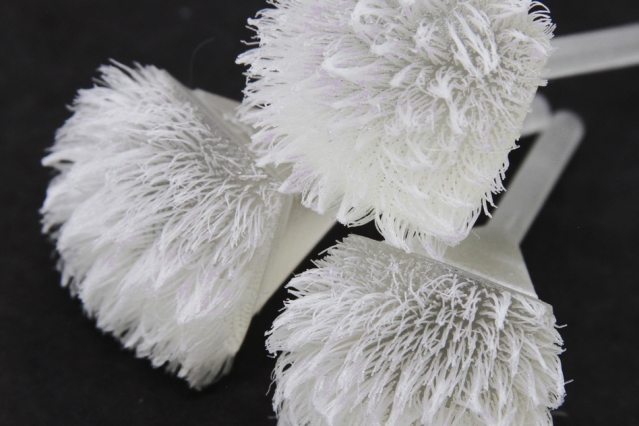
These days, it may seem as if 3-D printers can spit out just about anything, from a full-sized sports car, to edible food, to human skin. But some things have defied the technology, including hair, fur, and other dense arrays of extremely fine features, which require a huge amount of computational time and power to first design, then print.
Now researchers in MIT’s Media Lab have found a way to bypass a major design step in 3-D printing, to quickly and efficiently model and print thousands of hair-like structures. Instead of using conventional computer-aided design (CAD) software to draw thousands of individual hairs on a computer — a step that would take hours to compute — the team built a new software platform, called “Cilllia,” that lets users define the angle, thickness, density, and height of thousands of hairs, in just a few minutes.
Using the new software, the researchers designed arrays of hair-like structures with a resolution of 50 microns — about the width of a human hair. Playing with various dimensions, they designed and then printed arrays ranging from coarse bristles to fine fur, onto flat and also curved surfaces, using a conventional 3-D printer. They presented a paper detailing the results at the Association for Computing Machinery’s CHI Conference on Human Factors in Computing Systems in May.
Could the technology be used to print wigs and hair extensions? Possibly, say the researchers. But that’s not their end goal. Instead, they’re seeing how 3-D-printed hair could perform useful tasks such as sensing, adhesion, and actuation.
3D printing is gaining more popularity around the world. Human organs, homes and other things are produced with a 3d printer. But have you seen vehicles being printed?
Now, an American Company has created a self-driving minibus with the help of the 3d printing technology. It’s called Olli and is capable of carrying up to twelve passengers. The bus takes only 10 hours to be printed and an hour to assemble.
Olli was designed as an on-demand transportation solution that passengers can summon with a mobile app and the cool thing about this autonomous electric is that you can easily tell it where you're heading in natural language.
The company’s co-founder John Rogers is planning to build hundreds of micro-factories all over the world that can 3D-print Ollis.
European aircraft manufacturer Airbus unveiled its fully 3D printed Unmanned Test Aircraft at the ILA Berlin Airshow. The 3D printed UAV, named THOR (Test of High-tech Objectives in Reality) is a flyable 4×4 m subscale model plane and demonstrates the opportunities for future fast track product development using ALM (Additive Layer Manufacturing).
The unmanned aircraft was first tested in November 2015, taking flight for 40 km from Hamburg to Airbus’ plant in Stade, Germany. Constructed in just four weeks, THOR weighs 25kg and has a length and a wingspan of approximately four metres. Following successful tests, 18 missions have been scheduled for 2016.
According to Peter Sander, head of emerging technologies & concepts at Airbus in Hamburg, Germany, the aircraft will serve as a test platform for high risk and aerodynamic investigations, which will be used to further prove the viability the concept of a 3D printed UAV. THOR is comprised of around fifty 3D printed parts, two electric motors, and a remote control.
In just a few days, a building that architects are heralding as the world’s first 3D-printed office building will open in Dubai.
Inaugurated this past week and opening Tuesday, the new executive offices of the Dubai Future Foundation are made of concrete elements printed in Shanghai with a 120-foot-long 3D printer. The pieces were then shipped to the United Arab Emirates, as illustrated in the video below released by the official media office of Dubai:
Test Although displays made of organic light-emitting diodes (OLEDs) offer many advantages, they are difficult to produce using conventional methods. That’s why the printer manufacturer Seiko Epson is working together with Merck to develop technologies for printing OLED displays. Initial results show that the technique works in practice.
Test Displays made of organic light-emitting diodes (OLEDs) improve the television viewing experience by offering brilliant colors and extremely sharp contrasts irrespective of the viewing angle. And unlike conventional liquid crystal displays (LCDs), the self-luminous OLEDs do not need any backlighting. As a result, they consume less electricity.
Pinpoint precision in production
The individual pixels, each of which consists of one red, one green, and one blue light-emitting diode, have a filigree structure that poses a considerable challenge for the production of OLED displays. More
With an increasing demand for
specific applications and eliminating dependability on smartphones,
manufacturers aim to develop independent devices.
Wearable technology, also known as wearables, are accessories
that incorporate computer and electronic technologies to perform various
functions. A device consists of electronics, sensors, software, and
connectivity to enable data exchange for personal as well as business use.
These devices are generally used as fitness tracker, media devices, navigation
tools, health issue monitor, communication tool, and others. Wearables are able
to perform operations, such as real time data monitoring, logical calculations,
network communication, and others. It is usually used in integration with
smartphones to obtain better results. The wearable technology market will be
shaped in the future depending on how consumers use it with smartphones or adopt
it as an alternative.